\[
\newcommand{\figleft}{{\em (Left)}}
\newcommand{\figcenter}{{\em (Center)}}
\newcommand{\figright}{{\em (Right)}}
\newcommand{\figtop}{{\em (Top)}}
\newcommand{\figbottom}{{\em (Bottom)}}
\newcommand{\captiona}{{\em (a)}}
\newcommand{\captionb}{{\em (b)}}
\newcommand{\captionc}{{\em (c)}}
\newcommand{\captiond}{{\em (d)}}
\newcommand{\newterm}[1]{{\bf #1}}
\def\figref#1{figure~\ref{#1}}
\def\Figref#1{Figure~\ref{#1}}
\def\twofigref#1#2{figures \ref{#1} and \ref{#2}}
\def\quadfigref#1#2#3#4{figures \ref{#1}, \ref{#2}, \ref{#3} and \ref{#4}}
\def\secref#1{section~\ref{#1}}
\def\Secref#1{Section~\ref{#1}}
\def\twosecrefs#1#2{sections \ref{#1} and \ref{#2}}
\def\secrefs#1#2#3{sections \ref{#1}, \ref{#2} and \ref{#3}}
\def\eqref#1{equation~\ref{#1}}
\def\Eqref#1{Equation~\ref{#1}}
\def\plaineqref#1{\ref{#1}}
\def\chapref#1{chapter~\ref{#1}}
\def\Chapref#1{Chapter~\ref{#1}}
\def\rangechapref#1#2{chapters\ref{#1}--\ref{#2}}
\def\algref#1{algorithm~\ref{#1}}
\def\Algref#1{Algorithm~\ref{#1}}
\def\twoalgref#1#2{algorithms \ref{#1} and \ref{#2}}
\def\Twoalgref#1#2{Algorithms \ref{#1} and \ref{#2}}
\def\partref#1{part~\ref{#1}}
\def\Partref#1{Part~\ref{#1}}
\def\twopartref#1#2{parts \ref{#1} and \ref{#2}}
\def\ceil#1{\lceil #1 \rceil}
\def\floor#1{\lfloor #1 \rfloor}
\def\1{\bm{1}}
\newcommand{\train}{\mathcal{D}}
\newcommand{\valid}{\mathcal{D_{\mathrm{valid}}}}
\newcommand{\test}{\mathcal{D_{\mathrm{test}}}}
\def\eps{{\epsilon}}
\def\reta{{\textnormal{$\eta$}}}
\def\ra{{\textnormal{a}}}
\def\rb{{\textnormal{b}}}
\def\rc{{\textnormal{c}}}
\def\rd{{\textnormal{d}}}
\def\re{{\textnormal{e}}}
\def\rf{{\textnormal{f}}}
\def\rg{{\textnormal{g}}}
\def\rh{{\textnormal{h}}}
\def\ri{{\textnormal{i}}}
\def\rj{{\textnormal{j}}}
\def\rk{{\textnormal{k}}}
\def\rl{{\textnormal{l}}}
\def\rn{{\textnormal{n}}}
\def\ro{{\textnormal{o}}}
\def\rp{{\textnormal{p}}}
\def\rq{{\textnormal{q}}}
\def\rr{{\textnormal{r}}}
\def\rs{{\textnormal{s}}}
\def\rt{{\textnormal{t}}}
\def\ru{{\textnormal{u}}}
\def\rv{{\textnormal{v}}}
\def\rw{{\textnormal{w}}}
\def\rx{{\textnormal{x}}}
\def\ry{{\textnormal{y}}}
\def\rz{{\textnormal{z}}}
\def\rvepsilon{{\mathbf{\epsilon}}}
\def\rvtheta{{\mathbf{\theta}}}
\def\rva{{\mathbf{a}}}
\def\rvb{{\mathbf{b}}}
\def\rvc{{\mathbf{c}}}
\def\rvd{{\mathbf{d}}}
\def\rve{{\mathbf{e}}}
\def\rvf{{\mathbf{f}}}
\def\rvg{{\mathbf{g}}}
\def\rvh{{\mathbf{h}}}
\def\rvu{{\mathbf{i}}}
\def\rvj{{\mathbf{j}}}
\def\rvk{{\mathbf{k}}}
\def\rvl{{\mathbf{l}}}
\def\rvm{{\mathbf{m}}}
\def\rvn{{\mathbf{n}}}
\def\rvo{{\mathbf{o}}}
\def\rvp{{\mathbf{p}}}
\def\rvq{{\mathbf{q}}}
\def\rvr{{\mathbf{r}}}
\def\rvs{{\mathbf{s}}}
\def\rvt{{\mathbf{t}}}
\def\rvu{{\mathbf{u}}}
\def\rvv{{\mathbf{v}}}
\def\rvw{{\mathbf{w}}}
\def\rvx{{\mathbf{x}}}
\def\rvy{{\mathbf{y}}}
\def\rvz{{\mathbf{z}}}
\def\erva{{\textnormal{a}}}
\def\ervb{{\textnormal{b}}}
\def\ervc{{\textnormal{c}}}
\def\ervd{{\textnormal{d}}}
\def\erve{{\textnormal{e}}}
\def\ervf{{\textnormal{f}}}
\def\ervg{{\textnormal{g}}}
\def\ervh{{\textnormal{h}}}
\def\ervi{{\textnormal{i}}}
\def\ervj{{\textnormal{j}}}
\def\ervk{{\textnormal{k}}}
\def\ervl{{\textnormal{l}}}
\def\ervm{{\textnormal{m}}}
\def\ervn{{\textnormal{n}}}
\def\ervo{{\textnormal{o}}}
\def\ervp{{\textnormal{p}}}
\def\ervq{{\textnormal{q}}}
\def\ervr{{\textnormal{r}}}
\def\ervs{{\textnormal{s}}}
\def\ervt{{\textnormal{t}}}
\def\ervu{{\textnormal{u}}}
\def\ervv{{\textnormal{v}}}
\def\ervw{{\textnormal{w}}}
\def\ervx{{\textnormal{x}}}
\def\ervy{{\textnormal{y}}}
\def\ervz{{\textnormal{z}}}
\def\rmA{{\mathbf{A}}}
\def\rmB{{\mathbf{B}}}
\def\rmC{{\mathbf{C}}}
\def\rmD{{\mathbf{D}}}
\def\rmE{{\mathbf{E}}}
\def\rmF{{\mathbf{F}}}
\def\rmG{{\mathbf{G}}}
\def\rmH{{\mathbf{H}}}
\def\rmI{{\mathbf{I}}}
\def\rmJ{{\mathbf{J}}}
\def\rmK{{\mathbf{K}}}
\def\rmL{{\mathbf{L}}}
\def\rmM{{\mathbf{M}}}
\def\rmN{{\mathbf{N}}}
\def\rmO{{\mathbf{O}}}
\def\rmP{{\mathbf{P}}}
\def\rmQ{{\mathbf{Q}}}
\def\rmR{{\mathbf{R}}}
\def\rmS{{\mathbf{S}}}
\def\rmT{{\mathbf{T}}}
\def\rmU{{\mathbf{U}}}
\def\rmV{{\mathbf{V}}}
\def\rmW{{\mathbf{W}}}
\def\rmX{{\mathbf{X}}}
\def\rmY{{\mathbf{Y}}}
\def\rmZ{{\mathbf{Z}}}
\def\ermA{{\textnormal{A}}}
\def\ermB{{\textnormal{B}}}
\def\ermC{{\textnormal{C}}}
\def\ermD{{\textnormal{D}}}
\def\ermE{{\textnormal{E}}}
\def\ermF{{\textnormal{F}}}
\def\ermG{{\textnormal{G}}}
\def\ermH{{\textnormal{H}}}
\def\ermI{{\textnormal{I}}}
\def\ermJ{{\textnormal{J}}}
\def\ermK{{\textnormal{K}}}
\def\ermL{{\textnormal{L}}}
\def\ermM{{\textnormal{M}}}
\def\ermN{{\textnormal{N}}}
\def\ermO{{\textnormal{O}}}
\def\ermP{{\textnormal{P}}}
\def\ermQ{{\textnormal{Q}}}
\def\ermR{{\textnormal{R}}}
\def\ermS{{\textnormal{S}}}
\def\ermT{{\textnormal{T}}}
\def\ermU{{\textnormal{U}}}
\def\ermV{{\textnormal{V}}}
\def\ermW{{\textnormal{W}}}
\def\ermX{{\textnormal{X}}}
\def\ermY{{\textnormal{Y}}}
\def\ermZ{{\textnormal{Z}}}
\def\vzero{{\bm{0}}}
\def\vone{{\bm{1}}}
\def\vmu{{\bm{\mu}}}
\def\vtheta{{\bm{\theta}}}
\def\va{{\bm{a}}}
\def\vb{{\bm{b}}}
\def\vc{{\bm{c}}}
\def\vd{{\bm{d}}}
\def\ve{{\bm{e}}}
\def\vf{{\bm{f}}}
\def\vg{{\bm{g}}}
\def\vh{{\bm{h}}}
\def\vi{{\bm{i}}}
\def\vj{{\bm{j}}}
\def\vk{{\bm{k}}}
\def\vl{{\bm{l}}}
\def\vm{{\bm{m}}}
\def\vn{{\bm{n}}}
\def\vo{{\bm{o}}}
\def\vp{{\bm{p}}}
\def\vq{{\bm{q}}}
\def\vr{{\bm{r}}}
\def\vs{{\bm{s}}}
\def\vt{{\bm{t}}}
\def\vu{{\bm{u}}}
\def\vv{{\bm{v}}}
\def\vw{{\bm{w}}}
\def\vx{{\bm{x}}}
\def\vy{{\bm{y}}}
\def\vz{{\bm{z}}}
\def\evalpha{{\alpha}}
\def\evbeta{{\beta}}
\def\evepsilon{{\epsilon}}
\def\evlambda{{\lambda}}
\def\evomega{{\omega}}
\def\evmu{{\mu}}
\def\evpsi{{\psi}}
\def\evsigma{{\sigma}}
\def\evtheta{{\theta}}
\def\eva{{a}}
\def\evb{{b}}
\def\evc{{c}}
\def\evd{{d}}
\def\eve{{e}}
\def\evf{{f}}
\def\evg{{g}}
\def\evh{{h}}
\def\evi{{i}}
\def\evj{{j}}
\def\evk{{k}}
\def\evl{{l}}
\def\evm{{m}}
\def\evn{{n}}
\def\evo{{o}}
\def\evp{{p}}
\def\evq{{q}}
\def\evr{{r}}
\def\evs{{s}}
\def\evt{{t}}
\def\evu{{u}}
\def\evv{{v}}
\def\evw{{w}}
\def\evx{{x}}
\def\evy{{y}}
\def\evz{{z}}
\def\mA{{\bm{A}}}
\def\mB{{\bm{B}}}
\def\mC{{\bm{C}}}
\def\mD{{\bm{D}}}
\def\mE{{\bm{E}}}
\def\mF{{\bm{F}}}
\def\mG{{\bm{G}}}
\def\mH{{\bm{H}}}
\def\mI{{\bm{I}}}
\def\mJ{{\bm{J}}}
\def\mK{{\bm{K}}}
\def\mL{{\bm{L}}}
\def\mM{{\bm{M}}}
\def\mN{{\bm{N}}}
\def\mO{{\bm{O}}}
\def\mP{{\bm{P}}}
\def\mQ{{\bm{Q}}}
\def\mR{{\bm{R}}}
\def\mS{{\bm{S}}}
\def\mT{{\bm{T}}}
\def\mU{{\bm{U}}}
\def\mV{{\bm{V}}}
\def\mW{{\bm{W}}}
\def\mX{{\bm{X}}}
\def\mY{{\bm{Y}}}
\def\mZ{{\bm{Z}}}
\def\mBeta{{\bm{\beta}}}
\def\mPhi{{\bm{\Phi}}}
\def\mLambda{{\bm{\Lambda}}}
\def\mSigma{{\bm{\Sigma}}}
\newcommand{\tens}[1]{\bm{\mathsfit{#1}}}
\def\tA{{\tens{A}}}
\def\tB{{\tens{B}}}
\def\tC{{\tens{C}}}
\def\tD{{\tens{D}}}
\def\tE{{\tens{E}}}
\def\tF{{\tens{F}}}
\def\tG{{\tens{G}}}
\def\tH{{\tens{H}}}
\def\tI{{\tens{I}}}
\def\tJ{{\tens{J}}}
\def\tK{{\tens{K}}}
\def\tL{{\tens{L}}}
\def\tM{{\tens{M}}}
\def\tN{{\tens{N}}}
\def\tO{{\tens{O}}}
\def\tP{{\tens{P}}}
\def\tQ{{\tens{Q}}}
\def\tR{{\tens{R}}}
\def\tS{{\tens{S}}}
\def\tT{{\tens{T}}}
\def\tU{{\tens{U}}}
\def\tV{{\tens{V}}}
\def\tW{{\tens{W}}}
\def\tX{{\tens{X}}}
\def\tY{{\tens{Y}}}
\def\tZ{{\tens{Z}}}
\def\gA{{\mathcal{A}}}
\def\gB{{\mathcal{B}}}
\def\gC{{\mathcal{C}}}
\def\gD{{\mathcal{D}}}
\def\gE{{\mathcal{E}}}
\def\gF{{\mathcal{F}}}
\def\gG{{\mathcal{G}}}
\def\gH{{\mathcal{H}}}
\def\gI{{\mathcal{I}}}
\def\gJ{{\mathcal{J}}}
\def\gK{{\mathcal{K}}}
\def\gL{{\mathcal{L}}}
\def\gM{{\mathcal{M}}}
\def\gN{{\mathcal{N}}}
\def\gO{{\mathcal{O}}}
\def\gP{{\mathcal{P}}}
\def\gQ{{\mathcal{Q}}}
\def\gR{{\mathcal{R}}}
\def\gS{{\mathcal{S}}}
\def\gT{{\mathcal{T}}}
\def\gU{{\mathcal{U}}}
\def\gV{{\mathcal{V}}}
\def\gW{{\mathcal{W}}}
\def\gX{{\mathcal{X}}}
\def\gY{{\mathcal{Y}}}
\def\gZ{{\mathcal{Z}}}
\def\sA{{\mathbb{A}}}
\def\sB{{\mathbb{B}}}
\def\sC{{\mathbb{C}}}
\def\sD{{\mathbb{D}}}
\def\sF{{\mathbb{F}}}
\def\sG{{\mathbb{G}}}
\def\sH{{\mathbb{H}}}
\def\sI{{\mathbb{I}}}
\def\sJ{{\mathbb{J}}}
\def\sK{{\mathbb{K}}}
\def\sL{{\mathbb{L}}}
\def\sM{{\mathbb{M}}}
\def\sN{{\mathbb{N}}}
\def\sO{{\mathbb{O}}}
\def\sP{{\mathbb{P}}}
\def\sQ{{\mathbb{Q}}}
\def\sR{{\mathbb{R}}}
\def\sS{{\mathbb{S}}}
\def\sT{{\mathbb{T}}}
\def\sU{{\mathbb{U}}}
\def\sV{{\mathbb{V}}}
\def\sW{{\mathbb{W}}}
\def\sX{{\mathbb{X}}}
\def\sY{{\mathbb{Y}}}
\def\sZ{{\mathbb{Z}}}
\def\emLambda{{\Lambda}}
\def\emA{{A}}
\def\emB{{B}}
\def\emC{{C}}
\def\emD{{D}}
\def\emE{{E}}
\def\emF{{F}}
\def\emG{{G}}
\def\emH{{H}}
\def\emI{{I}}
\def\emJ{{J}}
\def\emK{{K}}
\def\emL{{L}}
\def\emM{{M}}
\def\emN{{N}}
\def\emO{{O}}
\def\emP{{P}}
\def\emQ{{Q}}
\def\emR{{R}}
\def\emS{{S}}
\def\emT{{T}}
\def\emU{{U}}
\def\emV{{V}}
\def\emW{{W}}
\def\emX{{X}}
\def\emY{{Y}}
\def\emZ{{Z}}
\def\emSigma{{\Sigma}}
\newcommand{\etens}[1]{\mathsfit{#1}}
\def\etLambda{{\etens{\Lambda}}}
\def\etA{{\etens{A}}}
\def\etB{{\etens{B}}}
\def\etC{{\etens{C}}}
\def\etD{{\etens{D}}}
\def\etE{{\etens{E}}}
\def\etF{{\etens{F}}}
\def\etG{{\etens{G}}}
\def\etH{{\etens{H}}}
\def\etI{{\etens{I}}}
\def\etJ{{\etens{J}}}
\def\etK{{\etens{K}}}
\def\etL{{\etens{L}}}
\def\etM{{\etens{M}}}
\def\etN{{\etens{N}}}
\def\etO{{\etens{O}}}
\def\etP{{\etens{P}}}
\def\etQ{{\etens{Q}}}
\def\etR{{\etens{R}}}
\def\etS{{\etens{S}}}
\def\etT{{\etens{T}}}
\def\etU{{\etens{U}}}
\def\etV{{\etens{V}}}
\def\etW{{\etens{W}}}
\def\etX{{\etens{X}}}
\def\etY{{\etens{Y}}}
\def\etZ{{\etens{Z}}}
\newcommand{\pdata}{p_{\rm{data}}}
\newcommand{\ptrain}{\hat{p}_{\rm{data}}}
\newcommand{\Ptrain}{\hat{P}_{\rm{data}}}
\newcommand{\pmodel}{p_{\rm{model}}}
\newcommand{\Pmodel}{P_{\rm{model}}}
\newcommand{\ptildemodel}{\tilde{p}_{\rm{model}}}
\newcommand{\pencode}{p_{\rm{encoder}}}
\newcommand{\pdecode}{p_{\rm{decoder}}}
\newcommand{\precons}{p_{\rm{reconstruct}}}
\newcommand{\E}{\mathbb{E}}
\newcommand{\Ls}{\mathcal{L}}
\newcommand{\R}{\mathbb{R}}
\newcommand{\emp}{\tilde{p}}
\newcommand{\lr}{\alpha}
\newcommand{\reg}{\lambda}
\newcommand{\rect}{\mathrm{rectifier}}
\newcommand{\softmax}{\mathrm{softmax}}
\newcommand{\sigmoid}{\sigma}
\newcommand{\softplus}{\zeta}
\newcommand{\KL}{D_{\mathrm{KL}}}
\newcommand{\Var}{\mathrm{Var}}
\newcommand{\standarderror}{\mathrm{SE}}
\newcommand{\Cov}{\mathrm{Cov}}
\newcommand{\normlzero}{L^0}
\newcommand{\normlone}{L^1}
\newcommand{\normltwo}{L^2}
\newcommand{\normlp}{L^p}
\newcommand{\normmax}{L^\infty}
\newcommand{\parents}{Pa} % See usage in notation.tex. Chosen to match Daphne's book.
\DeclareMathOperator*{\argmax}{arg\,max}
\DeclareMathOperator*{\argmin}{arg\,min}
\DeclareMathOperator{\sign}{sign}
\DeclareMathOperator{\Tr}{Tr}
\let\ab\allowbreak
\]
Implementing and maintaining a custom harness UI for Pi
2026-08-11
What is Pi?
pi is another ai harness, similar to opencode, claude-code or codex. It is a minimal harness, where none of the usual features such as default agent definitions, permission scheme etc are present. The idea is that the user can implement their own features by writing (or installing) typescript extensions.
Why I tried it
I tried it out because was tired of opencode hogging prompt cache. Once I started digging into what how opencode prompts are constructed, and realized that a lot of are things that I don't need (e.g. I don't benefit from having instructions about frontend engineering in my system prompt). But I did like the permission structure of opencode, which allowed for this "plan" then "build" paradigm. But something I realized is that "planner" and "builder" are agents in opencode. So by switching between the two, I end up invalidating the whole prompt cache because the agent instruction at the top is changed. I only wanted the permission structure and not the prompt switching. I started by trying to implement my own agents that behaved similarly, but realized that some of the functionalities are baked into opencode and it was not trivial for me to get the desired behavior. So I decided to try out pi, which did not have any of those features pre-built, meaning that I could build it however I wanted.
Vibing my own extensions
Instead of installing extensions available on the marketplace, I decided to just implement my own. This because I learned my lesson about relying on other people to configure my software -- it might work for them (or the general public), but most of it is bloat for me because I don't use it. I had this experience with oh-my-zsh, so I decided to just tell my agent to implement only the features I wanted. I won't go into the details of what this looks like, since I didn't manually touch the code much. My configuration is available here. Took me about a week's subscription of codex (this is before the 5.6 release and tokens got much cheaper) to get it pretty much to a state I was happy with.
nvim integration
Now, something that I was immediately tempted to do with pi was to implement a nice TUI for it. The opencode TUI was pretty nice (at least visually), and I wanted to make something similar. However, I also had some major gripes with opencode TUI (and many other CLIs as well). The main one is the lack of proper vim mode. In most CLIs, I can either open the input buffer in the built-in editor, or implement some limited vim-like features (which the developer is going to have to implement) that are not fully featured. And the lack of ability to scroll the output nicely (I would either have to use the built-in pager like in Opencode, or have to use tmux's copy mode, which is not bad but not ideal). And a really big one that no CLIs have (as far as I know) is the ability to open the input buffer in the system $EDITOR, while having the conversation still visible. My memory is limited, and I'm not going to be able to recall the entire conversation when I am drafting my next message. So I either need to jump back and forth from opening/closing the editor or have to deal with subpar editing experience. I guess there is no nice way to do this is why many CLIs don't implement it. But this is a pretty crucial feature.
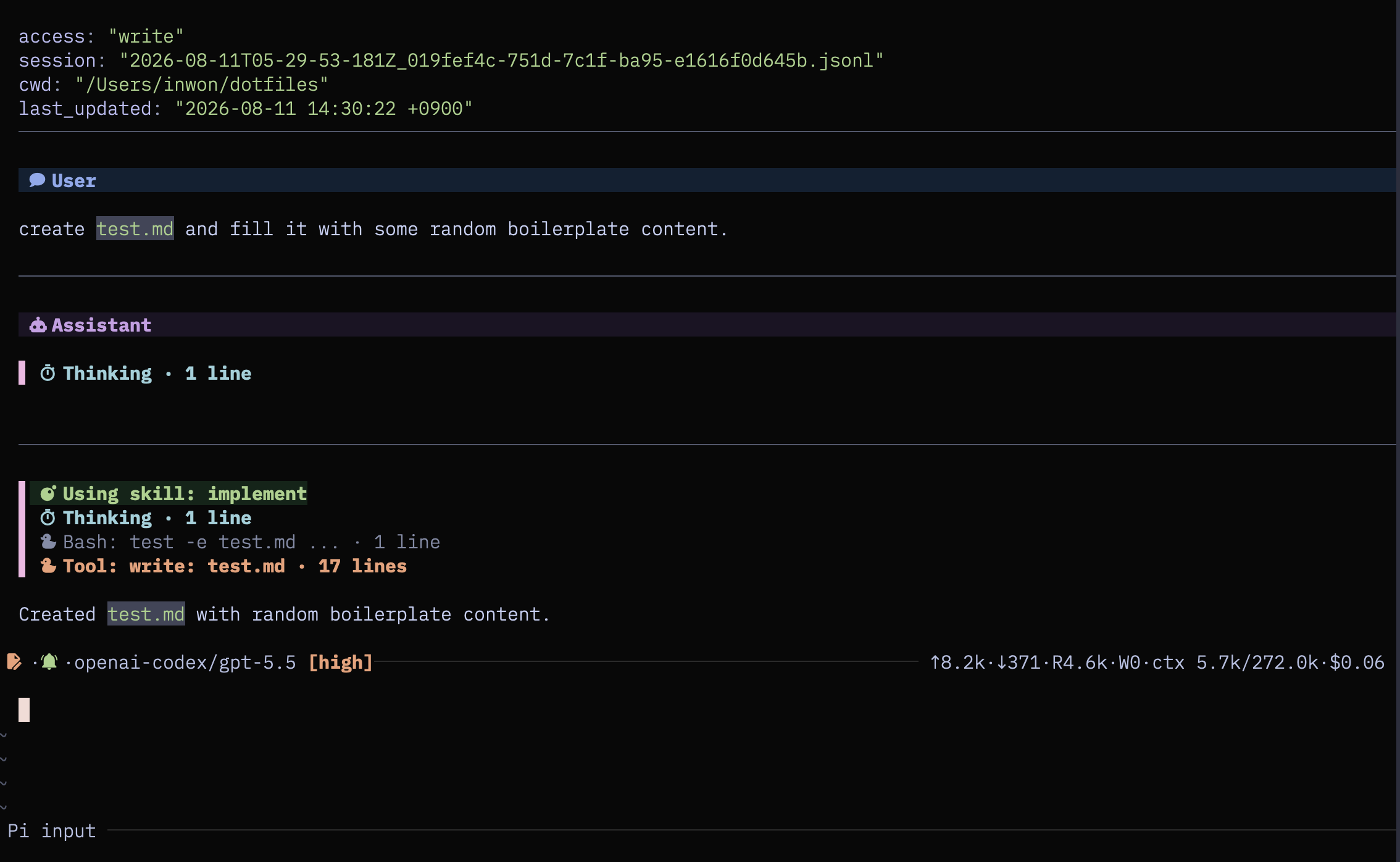
The more I thought about it, the more I realized that I am actually reinventing the wheel. neovim already does all of this -- vim mode, a notion of persistent buffer and resizable window panes. So I decided to implement a separate neovim config that I would use only for my pi harness -- I'm calling it pi-nvim, which I'm sure is taken by several other projects at this point. But doesn't matter, since this is just for me. I was then almost tempted to turn this into something official that I could share with others, but decided against it -- I'm making it for myself, so it is going to be very customized towards my existing nvim config. Plus, it really is pretty easy for one to implement this own their own using their agents as well. But I do believe that sharing this will be useful, as I'm sure many neovim users are probably capable of implementing this once they see the idea. My config is here -- so you can just install this and run it like NVIM_APPNAME=pi-nvim nvim and it will open up a neovim instance with my pi harness config. And I have some screenshots below in case you don't want to bother.
Main useful ideas
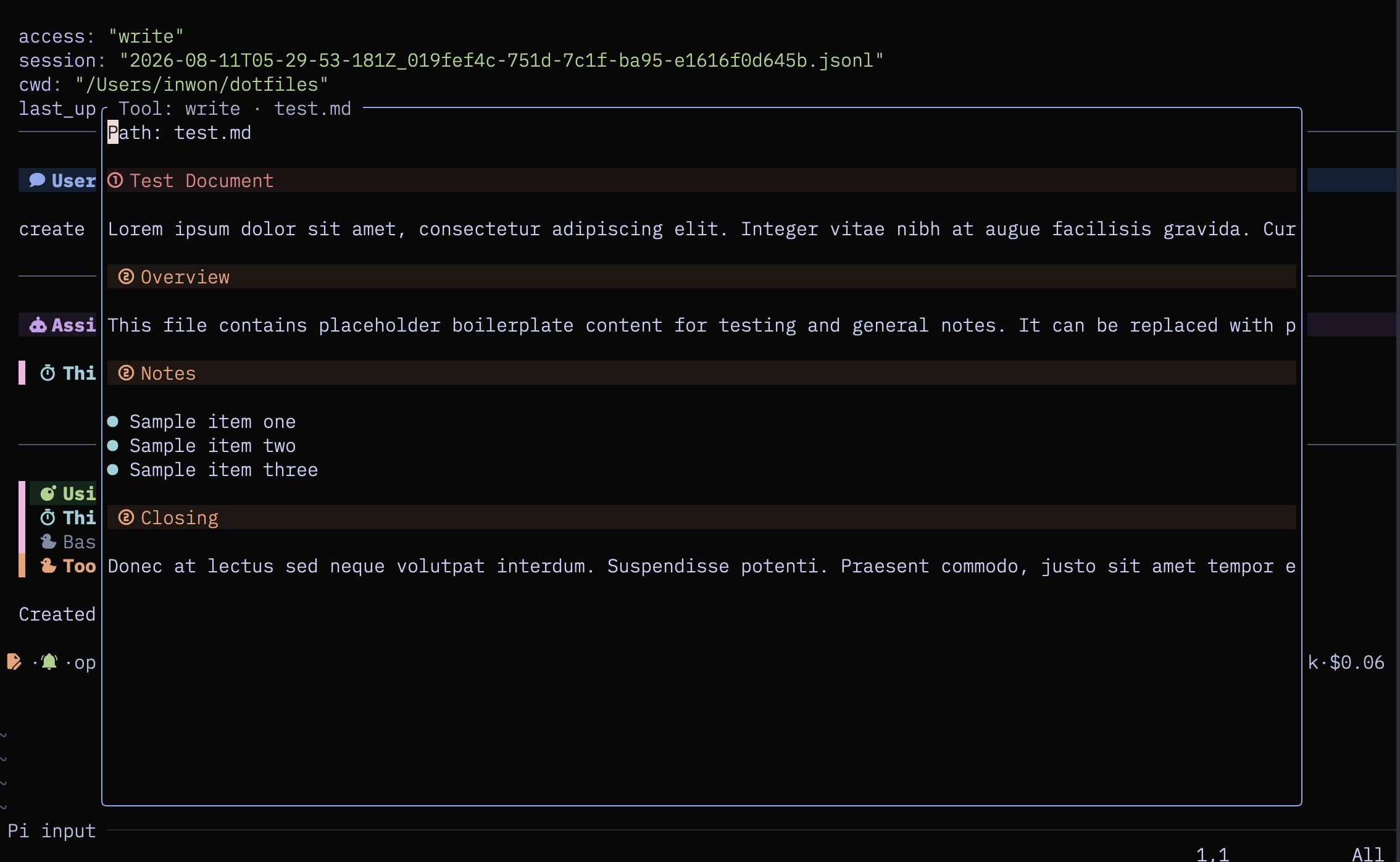
- using "quotes" to represent tool calls/though traces/edit diffs.
- they can be opened in a floating window. we can also make the different types of quotes look nice by changing the highlight group.
- some status bars -- this is nothing crazy, just enough that so that I can see the token count/if the agent is actually doing anything, etc.
Transcript view
Floating diff view
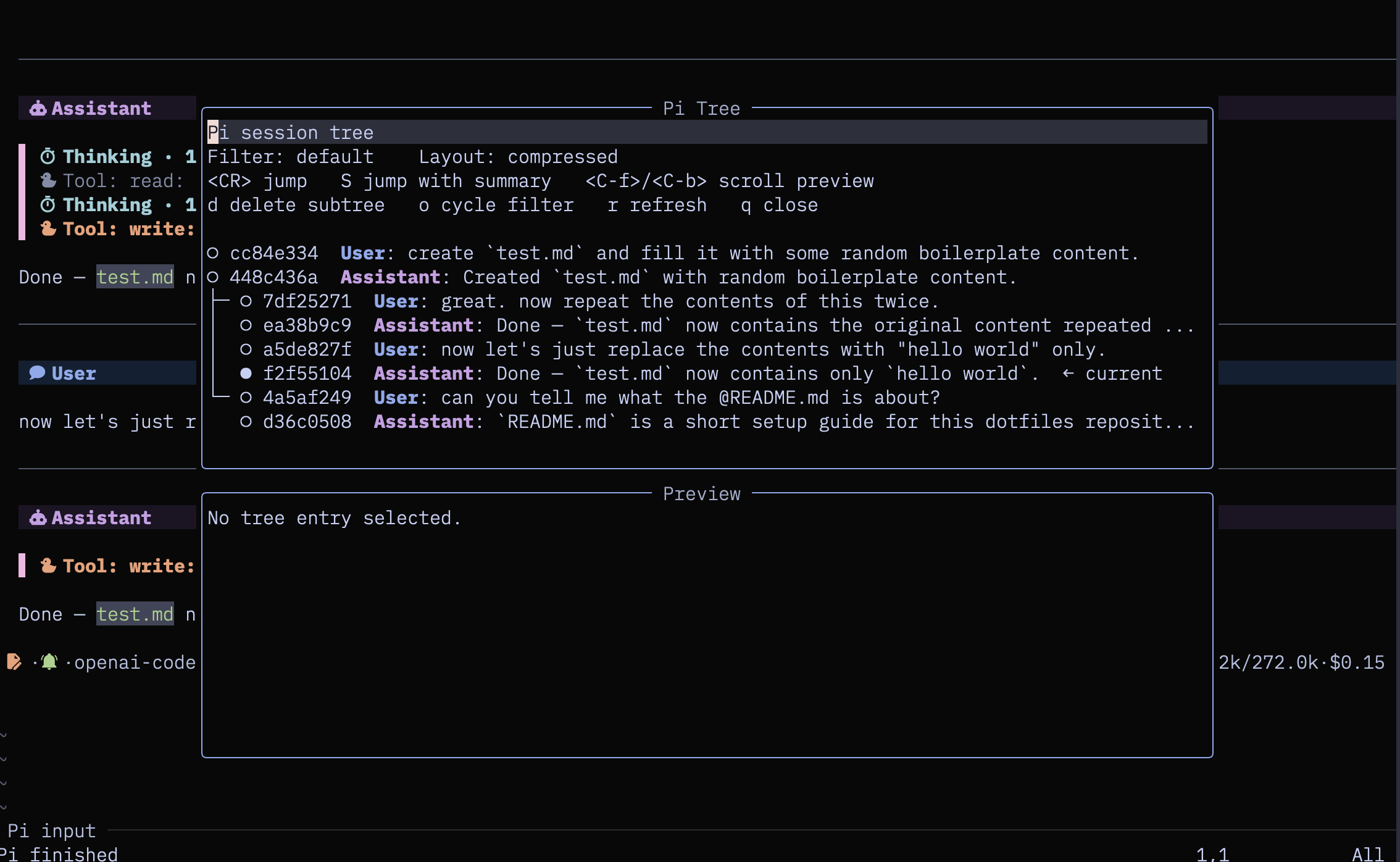
Tree selector
← Back to all randoms