\[ \newcommand{\figleft}{{\em (Left)}} \newcommand{\figcenter}{{\em (Center)}} \newcommand{\figright}{{\em (Right)}} \newcommand{\figtop}{{\em (Top)}} \newcommand{\figbottom}{{\em (Bottom)}} \newcommand{\captiona}{{\em (a)}} \newcommand{\captionb}{{\em (b)}} \newcommand{\captionc}{{\em (c)}} \newcommand{\captiond}{{\em (d)}} \newcommand{\newterm}[1]{{\bf #1}} \def\figref#1{figure~\ref{#1}} \def\Figref#1{Figure~\ref{#1}} \def\twofigref#1#2{figures \ref{#1} and \ref{#2}} \def\quadfigref#1#2#3#4{figures \ref{#1}, \ref{#2}, \ref{#3} and \ref{#4}} \def\secref#1{section~\ref{#1}} \def\Secref#1{Section~\ref{#1}} \def\twosecrefs#1#2{sections \ref{#1} and \ref{#2}} \def\secrefs#1#2#3{sections \ref{#1}, \ref{#2} and \ref{#3}} \def\eqref#1{equation~\ref{#1}} \def\Eqref#1{Equation~\ref{#1}} \def\plaineqref#1{\ref{#1}} \def\chapref#1{chapter~\ref{#1}} \def\Chapref#1{Chapter~\ref{#1}} \def\rangechapref#1#2{chapters\ref{#1}--\ref{#2}} \def\algref#1{algorithm~\ref{#1}} \def\Algref#1{Algorithm~\ref{#1}} \def\twoalgref#1#2{algorithms \ref{#1} and \ref{#2}} \def\Twoalgref#1#2{Algorithms \ref{#1} and \ref{#2}} \def\partref#1{part~\ref{#1}} \def\Partref#1{Part~\ref{#1}} \def\twopartref#1#2{parts \ref{#1} and \ref{#2}} \def\ceil#1{\lceil #1 \rceil} \def\floor#1{\lfloor #1 \rfloor} \def\1{\bm{1}} \newcommand{\train}{\mathcal{D}} \newcommand{\valid}{\mathcal{D_{\mathrm{valid}}}} \newcommand{\test}{\mathcal{D_{\mathrm{test}}}} \def\eps{{\epsilon}} \def\reta{{\textnormal{$\eta$}}} \def\ra{{\textnormal{a}}} \def\rb{{\textnormal{b}}} \def\rc{{\textnormal{c}}} \def\rd{{\textnormal{d}}} \def\re{{\textnormal{e}}} \def\rf{{\textnormal{f}}} \def\rg{{\textnormal{g}}} \def\rh{{\textnormal{h}}} \def\ri{{\textnormal{i}}} \def\rj{{\textnormal{j}}} \def\rk{{\textnormal{k}}} \def\rl{{\textnormal{l}}} \def\rn{{\textnormal{n}}} \def\ro{{\textnormal{o}}} \def\rp{{\textnormal{p}}} \def\rq{{\textnormal{q}}} \def\rr{{\textnormal{r}}} \def\rs{{\textnormal{s}}} \def\rt{{\textnormal{t}}} \def\ru{{\textnormal{u}}} \def\rv{{\textnormal{v}}} \def\rw{{\textnormal{w}}} \def\rx{{\textnormal{x}}} \def\ry{{\textnormal{y}}} \def\rz{{\textnormal{z}}} \def\rvepsilon{{\mathbf{\epsilon}}} \def\rvtheta{{\mathbf{\theta}}} \def\rva{{\mathbf{a}}} \def\rvb{{\mathbf{b}}} \def\rvc{{\mathbf{c}}} \def\rvd{{\mathbf{d}}} \def\rve{{\mathbf{e}}} \def\rvf{{\mathbf{f}}} \def\rvg{{\mathbf{g}}} \def\rvh{{\mathbf{h}}} \def\rvu{{\mathbf{i}}} \def\rvj{{\mathbf{j}}} \def\rvk{{\mathbf{k}}} \def\rvl{{\mathbf{l}}} \def\rvm{{\mathbf{m}}} \def\rvn{{\mathbf{n}}} \def\rvo{{\mathbf{o}}} \def\rvp{{\mathbf{p}}} \def\rvq{{\mathbf{q}}} \def\rvr{{\mathbf{r}}} \def\rvs{{\mathbf{s}}} \def\rvt{{\mathbf{t}}} \def\rvu{{\mathbf{u}}} \def\rvv{{\mathbf{v}}} \def\rvw{{\mathbf{w}}} \def\rvx{{\mathbf{x}}} \def\rvy{{\mathbf{y}}} \def\rvz{{\mathbf{z}}} \def\erva{{\textnormal{a}}} \def\ervb{{\textnormal{b}}} \def\ervc{{\textnormal{c}}} \def\ervd{{\textnormal{d}}} \def\erve{{\textnormal{e}}} \def\ervf{{\textnormal{f}}} \def\ervg{{\textnormal{g}}} \def\ervh{{\textnormal{h}}} \def\ervi{{\textnormal{i}}} \def\ervj{{\textnormal{j}}} \def\ervk{{\textnormal{k}}} \def\ervl{{\textnormal{l}}} \def\ervm{{\textnormal{m}}} \def\ervn{{\textnormal{n}}} \def\ervo{{\textnormal{o}}} \def\ervp{{\textnormal{p}}} \def\ervq{{\textnormal{q}}} \def\ervr{{\textnormal{r}}} \def\ervs{{\textnormal{s}}} \def\ervt{{\textnormal{t}}} \def\ervu{{\textnormal{u}}} \def\ervv{{\textnormal{v}}} \def\ervw{{\textnormal{w}}} \def\ervx{{\textnormal{x}}} \def\ervy{{\textnormal{y}}} \def\ervz{{\textnormal{z}}} \def\rmA{{\mathbf{A}}} \def\rmB{{\mathbf{B}}} \def\rmC{{\mathbf{C}}} \def\rmD{{\mathbf{D}}} \def\rmE{{\mathbf{E}}} \def\rmF{{\mathbf{F}}} \def\rmG{{\mathbf{G}}} \def\rmH{{\mathbf{H}}} \def\rmI{{\mathbf{I}}} \def\rmJ{{\mathbf{J}}} \def\rmK{{\mathbf{K}}} \def\rmL{{\mathbf{L}}} \def\rmM{{\mathbf{M}}} \def\rmN{{\mathbf{N}}} \def\rmO{{\mathbf{O}}} \def\rmP{{\mathbf{P}}} \def\rmQ{{\mathbf{Q}}} \def\rmR{{\mathbf{R}}} \def\rmS{{\mathbf{S}}} \def\rmT{{\mathbf{T}}} \def\rmU{{\mathbf{U}}} \def\rmV{{\mathbf{V}}} \def\rmW{{\mathbf{W}}} \def\rmX{{\mathbf{X}}} \def\rmY{{\mathbf{Y}}} \def\rmZ{{\mathbf{Z}}} \def\ermA{{\textnormal{A}}} \def\ermB{{\textnormal{B}}} \def\ermC{{\textnormal{C}}} \def\ermD{{\textnormal{D}}} \def\ermE{{\textnormal{E}}} \def\ermF{{\textnormal{F}}} \def\ermG{{\textnormal{G}}} \def\ermH{{\textnormal{H}}} \def\ermI{{\textnormal{I}}} \def\ermJ{{\textnormal{J}}} \def\ermK{{\textnormal{K}}} \def\ermL{{\textnormal{L}}} \def\ermM{{\textnormal{M}}} \def\ermN{{\textnormal{N}}} \def\ermO{{\textnormal{O}}} \def\ermP{{\textnormal{P}}} \def\ermQ{{\textnormal{Q}}} \def\ermR{{\textnormal{R}}} \def\ermS{{\textnormal{S}}} \def\ermT{{\textnormal{T}}} \def\ermU{{\textnormal{U}}} \def\ermV{{\textnormal{V}}} \def\ermW{{\textnormal{W}}} \def\ermX{{\textnormal{X}}} \def\ermY{{\textnormal{Y}}} \def\ermZ{{\textnormal{Z}}} \def\vzero{{\bm{0}}} \def\vone{{\bm{1}}} \def\vmu{{\bm{\mu}}} \def\vtheta{{\bm{\theta}}} \def\va{{\bm{a}}} \def\vb{{\bm{b}}} \def\vc{{\bm{c}}} \def\vd{{\bm{d}}} \def\ve{{\bm{e}}} \def\vf{{\bm{f}}} \def\vg{{\bm{g}}} \def\vh{{\bm{h}}} \def\vi{{\bm{i}}} \def\vj{{\bm{j}}} \def\vk{{\bm{k}}} \def\vl{{\bm{l}}} \def\vm{{\bm{m}}} \def\vn{{\bm{n}}} \def\vo{{\bm{o}}} \def\vp{{\bm{p}}} \def\vq{{\bm{q}}} \def\vr{{\bm{r}}} \def\vs{{\bm{s}}} \def\vt{{\bm{t}}} \def\vu{{\bm{u}}} \def\vv{{\bm{v}}} \def\vw{{\bm{w}}} \def\vx{{\bm{x}}} \def\vy{{\bm{y}}} \def\vz{{\bm{z}}} \def\evalpha{{\alpha}} \def\evbeta{{\beta}} \def\evepsilon{{\epsilon}} \def\evlambda{{\lambda}} \def\evomega{{\omega}} \def\evmu{{\mu}} \def\evpsi{{\psi}} \def\evsigma{{\sigma}} \def\evtheta{{\theta}} \def\eva{{a}} \def\evb{{b}} \def\evc{{c}} \def\evd{{d}} \def\eve{{e}} \def\evf{{f}} \def\evg{{g}} \def\evh{{h}} \def\evi{{i}} \def\evj{{j}} \def\evk{{k}} \def\evl{{l}} \def\evm{{m}} \def\evn{{n}} \def\evo{{o}} \def\evp{{p}} \def\evq{{q}} \def\evr{{r}} \def\evs{{s}} \def\evt{{t}} \def\evu{{u}} \def\evv{{v}} \def\evw{{w}} \def\evx{{x}} \def\evy{{y}} \def\evz{{z}} \def\mA{{\bm{A}}} \def\mB{{\bm{B}}} \def\mC{{\bm{C}}} \def\mD{{\bm{D}}} \def\mE{{\bm{E}}} \def\mF{{\bm{F}}} \def\mG{{\bm{G}}} \def\mH{{\bm{H}}} \def\mI{{\bm{I}}} \def\mJ{{\bm{J}}} \def\mK{{\bm{K}}} \def\mL{{\bm{L}}} \def\mM{{\bm{M}}} \def\mN{{\bm{N}}} \def\mO{{\bm{O}}} \def\mP{{\bm{P}}} \def\mQ{{\bm{Q}}} \def\mR{{\bm{R}}} \def\mS{{\bm{S}}} \def\mT{{\bm{T}}} \def\mU{{\bm{U}}} \def\mV{{\bm{V}}} \def\mW{{\bm{W}}} \def\mX{{\bm{X}}} \def\mY{{\bm{Y}}} \def\mZ{{\bm{Z}}} \def\mBeta{{\bm{\beta}}} \def\mPhi{{\bm{\Phi}}} \def\mLambda{{\bm{\Lambda}}} \def\mSigma{{\bm{\Sigma}}} \newcommand{\tens}[1]{\bm{\mathsfit{#1}}} \def\tA{{\tens{A}}} \def\tB{{\tens{B}}} \def\tC{{\tens{C}}} \def\tD{{\tens{D}}} \def\tE{{\tens{E}}} \def\tF{{\tens{F}}} \def\tG{{\tens{G}}} \def\tH{{\tens{H}}} \def\tI{{\tens{I}}} \def\tJ{{\tens{J}}} \def\tK{{\tens{K}}} \def\tL{{\tens{L}}} \def\tM{{\tens{M}}} \def\tN{{\tens{N}}} \def\tO{{\tens{O}}} \def\tP{{\tens{P}}} \def\tQ{{\tens{Q}}} \def\tR{{\tens{R}}} \def\tS{{\tens{S}}} \def\tT{{\tens{T}}} \def\tU{{\tens{U}}} \def\tV{{\tens{V}}} \def\tW{{\tens{W}}} \def\tX{{\tens{X}}} \def\tY{{\tens{Y}}} \def\tZ{{\tens{Z}}} \def\gA{{\mathcal{A}}} \def\gB{{\mathcal{B}}} \def\gC{{\mathcal{C}}} \def\gD{{\mathcal{D}}} \def\gE{{\mathcal{E}}} \def\gF{{\mathcal{F}}} \def\gG{{\mathcal{G}}} \def\gH{{\mathcal{H}}} \def\gI{{\mathcal{I}}} \def\gJ{{\mathcal{J}}} \def\gK{{\mathcal{K}}} \def\gL{{\mathcal{L}}} \def\gM{{\mathcal{M}}} \def\gN{{\mathcal{N}}} \def\gO{{\mathcal{O}}} \def\gP{{\mathcal{P}}} \def\gQ{{\mathcal{Q}}} \def\gR{{\mathcal{R}}} \def\gS{{\mathcal{S}}} \def\gT{{\mathcal{T}}} \def\gU{{\mathcal{U}}} \def\gV{{\mathcal{V}}} \def\gW{{\mathcal{W}}} \def\gX{{\mathcal{X}}} \def\gY{{\mathcal{Y}}} \def\gZ{{\mathcal{Z}}} \def\sA{{\mathbb{A}}} \def\sB{{\mathbb{B}}} \def\sC{{\mathbb{C}}} \def\sD{{\mathbb{D}}} \def\sF{{\mathbb{F}}} \def\sG{{\mathbb{G}}} \def\sH{{\mathbb{H}}} \def\sI{{\mathbb{I}}} \def\sJ{{\mathbb{J}}} \def\sK{{\mathbb{K}}} \def\sL{{\mathbb{L}}} \def\sM{{\mathbb{M}}} \def\sN{{\mathbb{N}}} \def\sO{{\mathbb{O}}} \def\sP{{\mathbb{P}}} \def\sQ{{\mathbb{Q}}} \def\sR{{\mathbb{R}}} \def\sS{{\mathbb{S}}} \def\sT{{\mathbb{T}}} \def\sU{{\mathbb{U}}} \def\sV{{\mathbb{V}}} \def\sW{{\mathbb{W}}} \def\sX{{\mathbb{X}}} \def\sY{{\mathbb{Y}}} \def\sZ{{\mathbb{Z}}} \def\emLambda{{\Lambda}} \def\emA{{A}} \def\emB{{B}} \def\emC{{C}} \def\emD{{D}} \def\emE{{E}} \def\emF{{F}} \def\emG{{G}} \def\emH{{H}} \def\emI{{I}} \def\emJ{{J}} \def\emK{{K}} \def\emL{{L}} \def\emM{{M}} \def\emN{{N}} \def\emO{{O}} \def\emP{{P}} \def\emQ{{Q}} \def\emR{{R}} \def\emS{{S}} \def\emT{{T}} \def\emU{{U}} \def\emV{{V}} \def\emW{{W}} \def\emX{{X}} \def\emY{{Y}} \def\emZ{{Z}} \def\emSigma{{\Sigma}} \newcommand{\etens}[1]{\mathsfit{#1}} \def\etLambda{{\etens{\Lambda}}} \def\etA{{\etens{A}}} \def\etB{{\etens{B}}} \def\etC{{\etens{C}}} \def\etD{{\etens{D}}} \def\etE{{\etens{E}}} \def\etF{{\etens{F}}} \def\etG{{\etens{G}}} \def\etH{{\etens{H}}} \def\etI{{\etens{I}}} \def\etJ{{\etens{J}}} \def\etK{{\etens{K}}} \def\etL{{\etens{L}}} \def\etM{{\etens{M}}} \def\etN{{\etens{N}}} \def\etO{{\etens{O}}} \def\etP{{\etens{P}}} \def\etQ{{\etens{Q}}} \def\etR{{\etens{R}}} \def\etS{{\etens{S}}} \def\etT{{\etens{T}}} \def\etU{{\etens{U}}} \def\etV{{\etens{V}}} \def\etW{{\etens{W}}} \def\etX{{\etens{X}}} \def\etY{{\etens{Y}}} \def\etZ{{\etens{Z}}} \newcommand{\pdata}{p_{\rm{data}}} \newcommand{\ptrain}{\hat{p}_{\rm{data}}} \newcommand{\Ptrain}{\hat{P}_{\rm{data}}} \newcommand{\pmodel}{p_{\rm{model}}} \newcommand{\Pmodel}{P_{\rm{model}}} \newcommand{\ptildemodel}{\tilde{p}_{\rm{model}}} \newcommand{\pencode}{p_{\rm{encoder}}} \newcommand{\pdecode}{p_{\rm{decoder}}} \newcommand{\precons}{p_{\rm{reconstruct}}} \newcommand{\E}{\mathbb{E}} \newcommand{\Ls}{\mathcal{L}} \newcommand{\R}{\mathbb{R}} \newcommand{\emp}{\tilde{p}} \newcommand{\lr}{\alpha} \newcommand{\reg}{\lambda} \newcommand{\rect}{\mathrm{rectifier}} \newcommand{\softmax}{\mathrm{softmax}} \newcommand{\sigmoid}{\sigma} \newcommand{\softplus}{\zeta} \newcommand{\KL}{D_{\mathrm{KL}}} \newcommand{\Var}{\mathrm{Var}} \newcommand{\standarderror}{\mathrm{SE}} \newcommand{\Cov}{\mathrm{Cov}} \newcommand{\normlzero}{L^0} \newcommand{\normlone}{L^1} \newcommand{\normltwo}{L^2} \newcommand{\normlp}{L^p} \newcommand{\normmax}{L^\infty} \newcommand{\parents}{Pa} % See usage in notation.tex. Chosen to match Daphne's book. \DeclareMathOperator*{\argmax}{arg\,max} \DeclareMathOperator*{\argmin}{arg\,min} \DeclareMathOperator{\sign}{sign} \DeclareMathOperator{\Tr}{Tr} \let\ab\allowbreak \]

Trompt: Towards a Better Deep Neural Network for Tabular Data

2025-01-16
language-model (7) pretrained-model (3) prompt-tuning (1) tabular-data (16)

Summary

The authors propose an in-context-learning architecture for classification on tabular data.

Approach

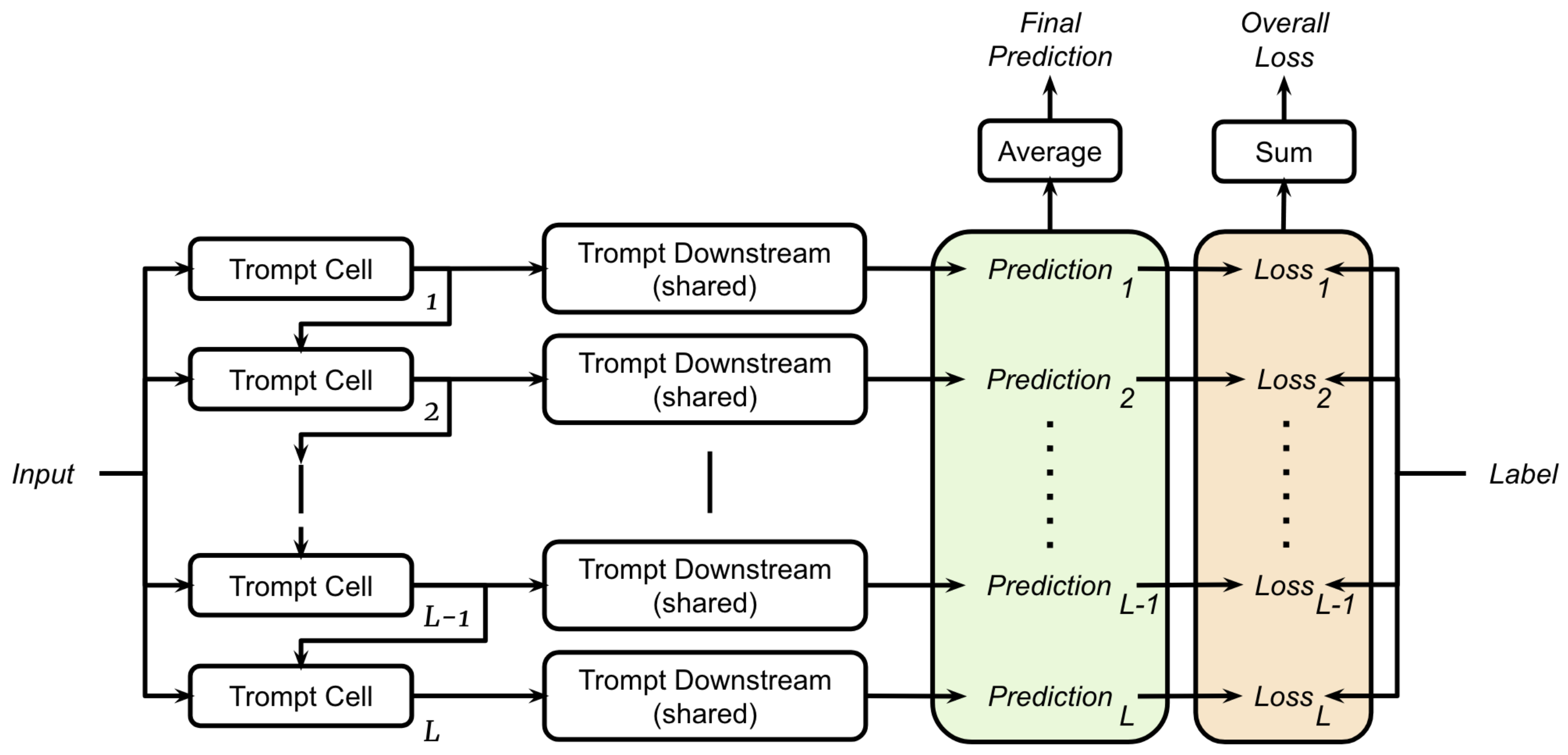
Overall architecture of Trompt

Overall architecture of Trompt
The Trompt model uses multiple **Trompt Cell**, each of which handles a **row** of a table. The $n$th cell receives the prompt generated by the $n-1$th cell.

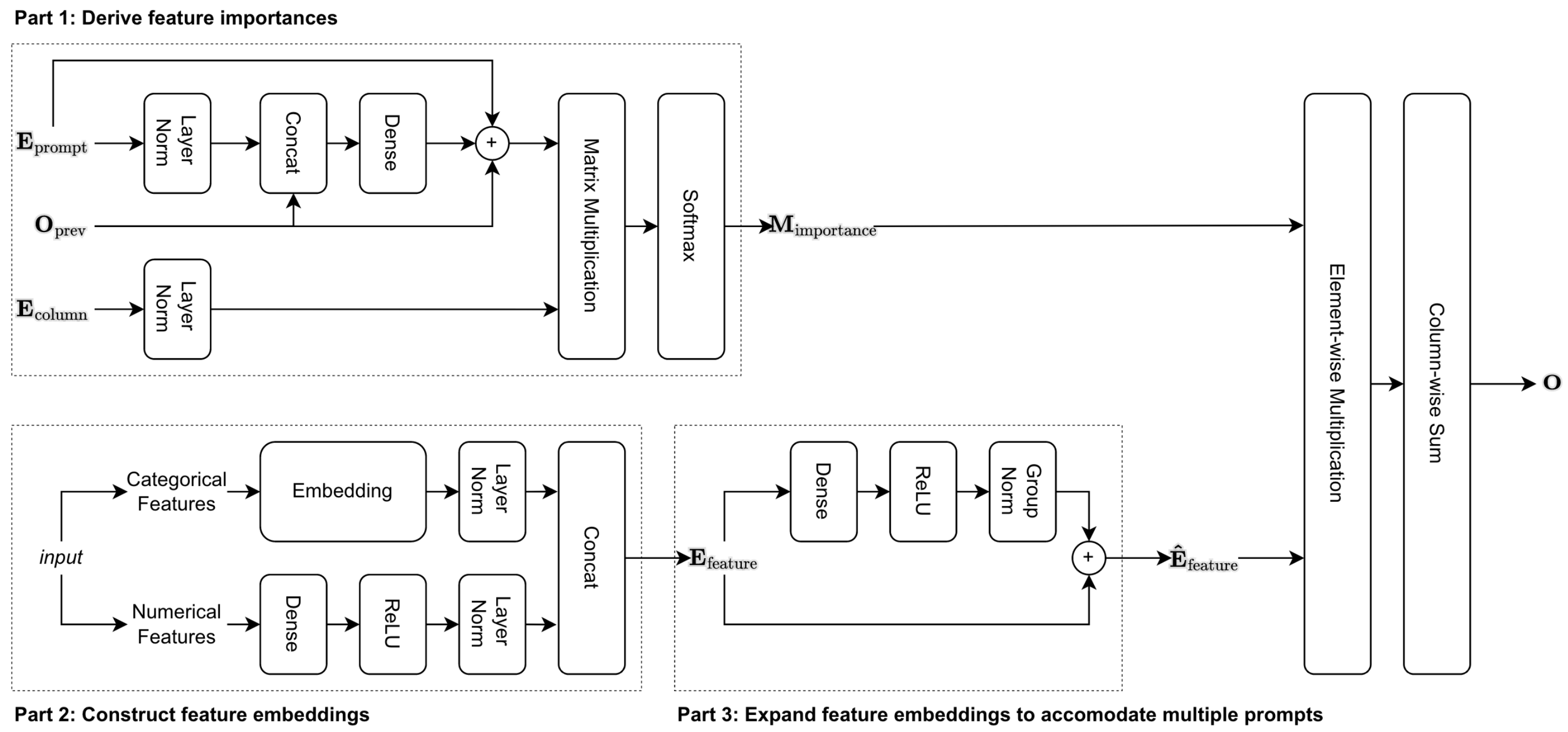
Trompt Cell

Trompt Cell
Illustration of a single Trompt cell. Part 1. shows using the previous prompt and column embeddings to generate the next prompt. Part 2 shows how actual input data is transformed, and Part 3 shows how the feature embeddings are expanded for usage with multiple prompts.
Setting
Given a table with $N$ rows $C$ columns, we want to learn a Trompt model that has a latent dimension of $d$, $L$ cells and $P$ soft-prompts.

Part 1. Feature Importance

The feature importance scores are computed by using the column embeddings \(\mE_{\text{column}} \in \R^{C\times d}\), soft-prompts \(\mE_{\text{prompt}} \in \R^{P \times d}\) and the previous Trompt cell's output \(\mO_{\text{prev}} \in \R^{B \times P \times d}\). Note that \(\mO_{\text{prev}}\) has an extra batch dimension because the data is loaded in batches. \(\mE_{\text{column}}\) and \(\mE_{\text{prompt}}\) are expanded into \(\mS\mE_{\text{column}} \in \R^{B \times C \times d}\) and \(\mS\mE_{\text{prompt}} \in \R^{B \times P \times d}\).

$$ \begin{gather*} \hat{\mS\mE}_{\text{prompt}} = \text{dense}(\text{concat}(\mS\mE_{\text{prompt}}, \mO_{\text{prev}})) + \mS\mE_{\text{prompt}} + \mO_{\text{prev}} \in \R^{B \times P \times d} \\ \mM_{\text{importance}} = \text{softmax}(\hat{\mS\mE}_{\text{prompt}} \otimes \mS\mE_{\text{column}}^T) \in \R^{B \times P \times C} \end{gather*} $$
Intuition
The authors say that this mechanism 'enables input-related representations to flow through and derive sample-specific feature importances'. The 'flow through' part comes from the fact that the $n$th cell sees what the $n-1$th cell did. The sample-specific part comes from the fact that the prompt is generated based on the previous prompt and input sample, and not by a table-wide importance score. We can think of this as a way to map the interaction between individual prompt tokens and the table columns. In other words, $(\mM_{\text{importance}})_{i,j,k}$ should tell us the importance of interaction between the $j$th prompt and the $k$th column for sample $i$.

Parts 2 & 3. Generating/Reshaping Feature Embeddings

Now that the per-instance feature importance scores are computed, the actual representation of the instance itself needs to be computed. This is done through a rather standard procedure12, using an embedding lookup table for categorical features and a dense layer for numerical features. This process yields \(\hat{\mE}_{\text{feature}} \in \R^{B \times C \times d}\). However, \(\hat{\mE}_{\text{feature}}\) cannot be directly used with the importance scores \(M_{\text{importance}}\) because the shapes do not match. To fix this, \(\mE_{\text{feature}}\) is transformed once more by a dense layer to turn into \(\R^{B \times P \times C \times d}\). Now we can expand \(\mM_{\text{importance}}\) into \(\R \in {B \times P \times C \times 1}\) and apply element-wise multiplication to compute the output of the Trompt layer.

$$ \mO = \sum_{i=1}^{C} (\mM_{\text{importance}} \otimes \hat{\mE}_{\text{feature}})_{:,:,i,:} \in \R^{B \times P \times d} $$

For classification, a weighted sum is applied to \(\mO\) to get the input to the downstream classifier by training a dense layer to compute the weights for each prompt.

$$ \begin{align*} \mW_{\text{prompt}} = \text{softmax}(\text{dense}(\mO)) \in \R^{B \times P} \\ \hat{\mO} = \sum_{i=1}^{P} (\mW_{\text{prompt}} \odot \mO)_{:,i,:} \in \R^{B \times d} \\ \mP = \text{softmax}(\text{dense}(\hat{\mO})) \in \R^{B \times T} \end{align*} $$

Where \(\mP\) is the prediction and \(T\) is the number of target classes.

Experiments

The authors focus on the WhyTrees benchmark3, which contains 45 datasets that were found to be difficult for both tree-based and deep learning models. Using this dataset, Trompt is compared against FT-Transformer1, SAINT2, ResNet3, XGB, LightGBM, Catboost, and Random Forest.

Findings

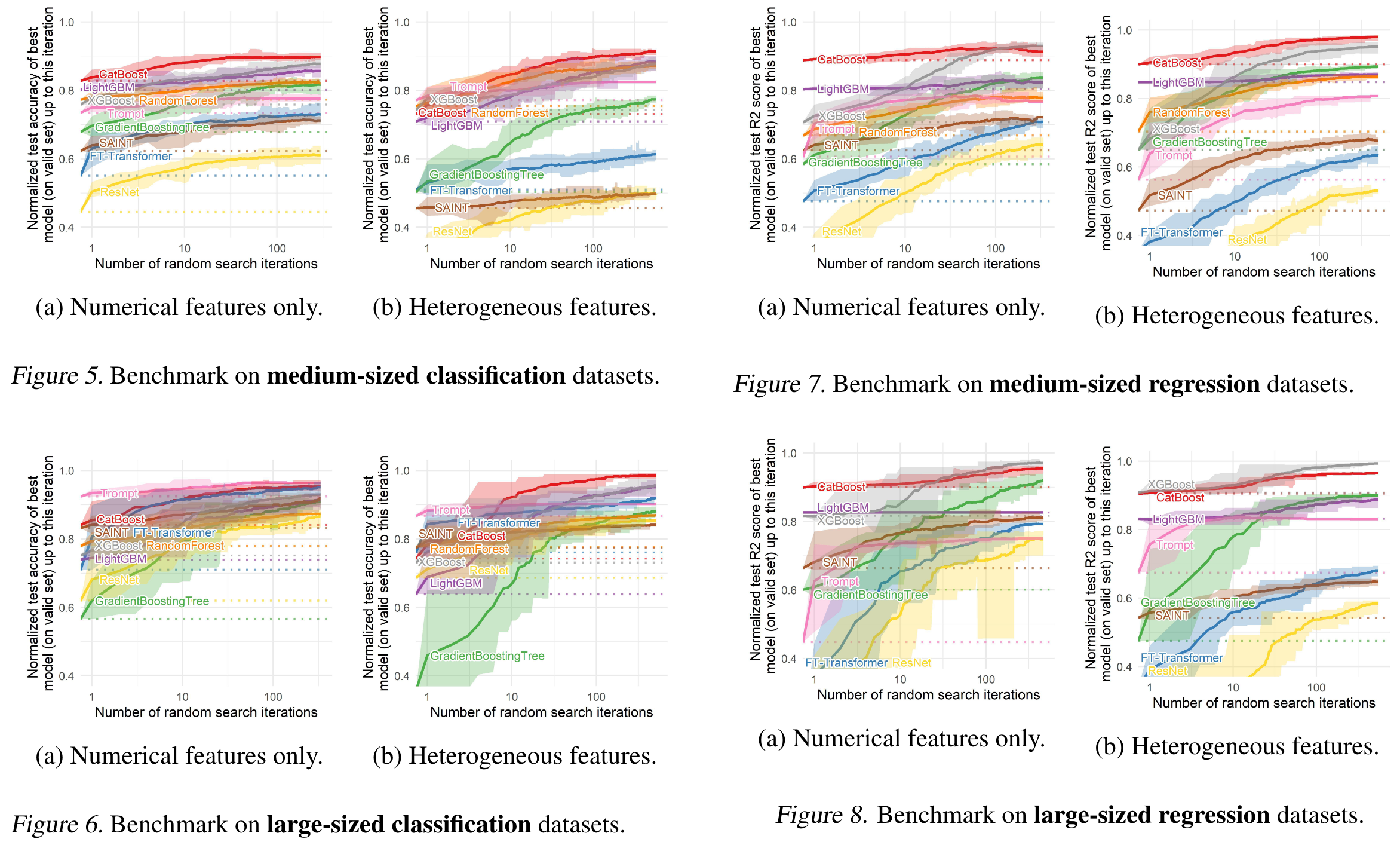
Main Results

Main Results
HPO comparison of performance grouped by task type (classification/regression) and dataset type (numerical only/heterogeneous).

Classification on medium datasets

Classification on large datasets

Regression on medium datasets

Regression on large datasets

HPO Ablation

Resources

  1. Gorishniy, Yury, Ivan Rubachev, Valentin Khrulkov, and Artem Babenko. "Revisiting deep learning models for tabular data." Advances in Neural Information Processing Systems 34 (2021): 18932-18943.

  2. Somepalli, Gowthami, Micah Goldblum, Avi Schwarzschild, C. Bayan Bruss, and Tom Goldstein. "Saint: Improved neural networks for tabular data via row attention and contrastive pre-training." arXiv preprint arXiv:2106.01342 (2021).

  3. Grinsztajn, Léo, Edouard Oyallon, and Gaël Varoquaux. "Why do tree-based models still outperform deep learning on typical tabular data?." Advances in neural information processing systems 35 (2022): 507-520.

← Back to all readings